

A Day Spent Rehearsing the Way In.
Airport Innovation Roundtable 2026 was the Bratislava edition of the AirCEE+ Airports Association's flagship forum, held at the Crowne Plaza on 16 and 17 September with Bratislava Airport as host partner. Just over a hundred decision-makers attended. Airport chief executives, regulators, a retired general, infrastructure providers and aviation media. The first day went to a technical tour of the airport and a welcome reception. The second carried the programme, opened by Denisa Žiláková, State Secretary at the Slovak Ministry of Transport, with Dušan Novota, CEO of Bratislava Airport, and Stanisław Wojtera, President of AirCEE+.

Olivier Jankovec, Director General of ACI EUROPE, delivered the market keynote. Lieutenant General Tadeusz Mikutel gave the Power Speech. Oleksiy Dubrevskyy, General Director of Kyiv Boryspil, took the midday slot with a special presentation on operating an airport through war.


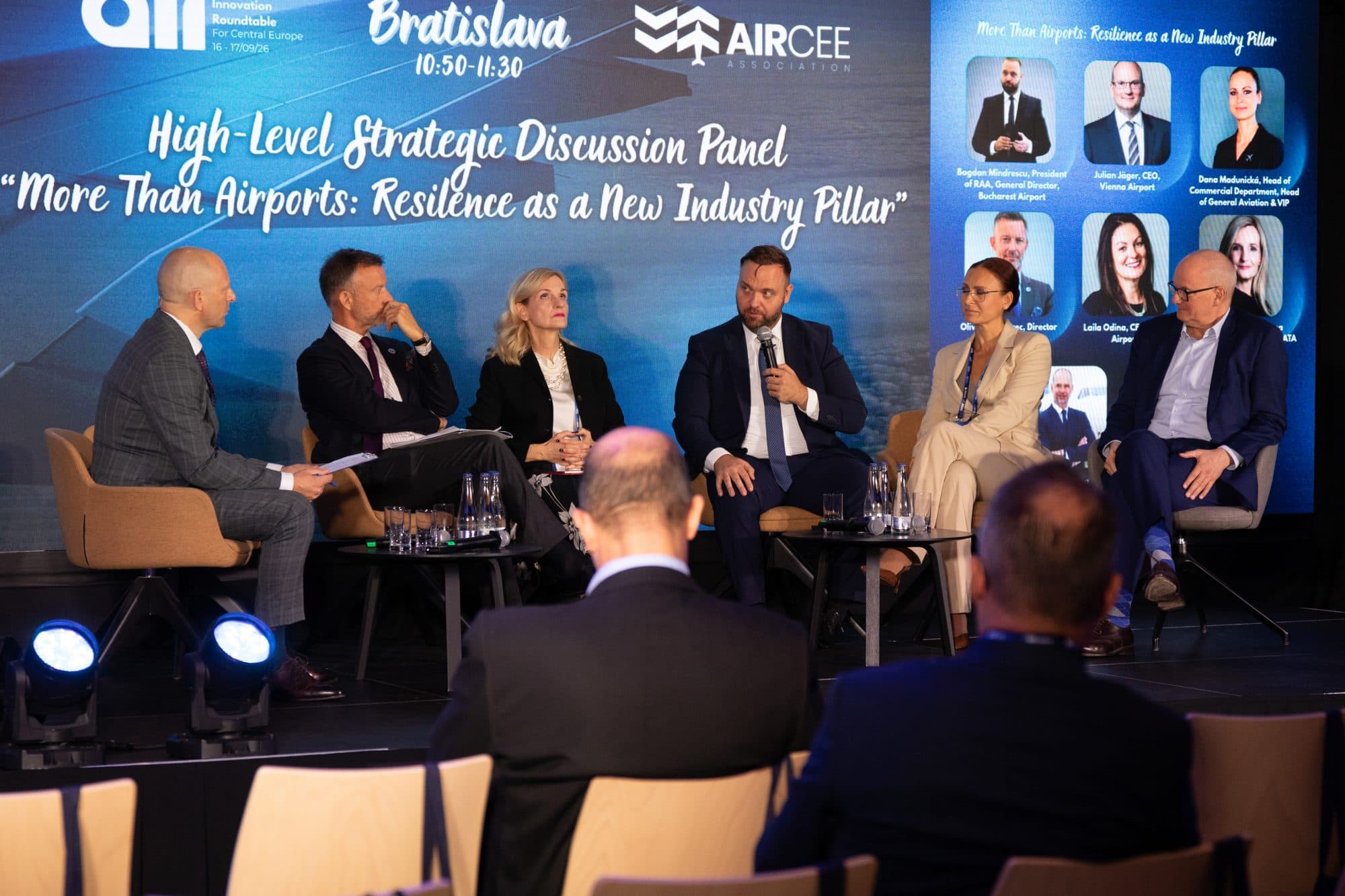
The resilience panel brought together Julian Jäger of Vienna Airport, Laila Odiņa of RIX Riga Airport, Bogdan Mîndrescu of Bucharest Airports, Marcin Osowski of ASE Baltic, Dana Madunická of Bratislava Airport and Anca Apahidean of IATA. The afternoon ran technical. Felix Sigel presented for SITA and Mikołaj Lis of Dimark led two sessions on baggage automation with Alexandros Noutsos of Heraklion, Tomasz Lenart of Wrocław, Michael Doughty of NACO and Henrik Elm Gulløv of Cobot Lift. Thomas Dworschak of Košice, Manuela Knotek of Vienna and Tomasz Kłosowicz of PwC took digital operations. Natalia Roj of Hill International chaired a session on expanding an airport while it runs, with Martin Kučera of Prague, Josip Klišmanić of Zadar, Michał Witkowski of Tirana and Professor Antonín Kazda of Žilina. The day closed on the region's funding dilemma, airports against routes, with Tatsiana Andrushka of Wrocław, Mihai Pătrașcu of Satu Mare, Răzvan Horga of Oradea and Nina Vojnić Žagar of Pula. PwC ran a closed workshop led by Todd Bradshaw, with Zuzana Palkechová on state aid for route expansion and Valeryia Drabinovich on EU funds for military mobility and dual-use infrastructure.

The theme was resilience. Across the day the room covered drone incursions, cyber incidents, snowfall, debt, capacity and the cost of being ready. No session on the agenda covered the reactivation of a closed airport. European law covers how an aerodrome certificate is issued, maintained, limited, suspended, revoked and voluntarily surrendered, and sets out no procedure for restarting one after years of involuntary dormancy. One speaker arrived with a written sequence for doing it.
The General's One-Way Trip.
Lieutenant General Tadeusz Mikutel flew fighter-bombers from 1985 and left the Polish air force in January 2023 after forty-one years. Billed for a talk on leadership under pressure, he spoke instead on protecting air infrastructure as strategic dual-use infrastructure. Airspace control transfers entirely to the military the moment a Supreme Commander is appointed, he said, and civilian traffic control ceases. Civil systems are physically removed, because non-secure equipment cannot receive classified military air planning data, and secret-level systems go in behind them. Encrypted ground-to-ground communications, which no civil operator holds today, become an operational requirement. Anti-aircraft artillery arrives, ground forces take outposts beyond the perimeter, and civil staff are moved off the field, unqualified to work beside ammunition.

He gave the figures for the people as well. Retraining a controller for a military tower in wartime takes one day, while moving a civil controller between two civil airports takes eighty hours. None of it can be improvised, he said, which is why the procedures must exist in peacetime, be tested and be exercised. Poland has stopped running the exercises it once ran, because the military no longer owns the airspace under the European framework, and he called for them to be restarted. The sequence he set out ran from peacetime through crisis to wartime operations.
Resilience, Defined Twice.

February's snow fell on Bucharest at more than sixteen centimetres an hour, the heaviest Bogdan Mîndrescu had seen in twenty years, and he kept both his airports working while regional neighbours closed. Then the Middle East conflict, overnight, then the air traffic system failure. Behind the word resilience, he said, is business continuity, and procedures are beside the point, because nobody gives you two days' notice. He put a question to the room, asking whether anyone present could say how long recovery takes once a system fails. Dana Madunická, who has run non-scheduled traffic at Bratislava since 2013, gave her own definition of the term. Resilience is the traffic you cannot turn away.
The Price of Being Ready.

Resilience costs money, Jankovec told the panel, and without it there is no operational, security or climate resilience to discuss. His example was Amsterdam Airport Schiphol, which held its charges down for fifteen years, externalised functions to manage it, and lost control of its own operation when traffic returned, a breakdown an official Dutch review tied to years of outsourcing. Against that he set 2.6 billion passengers through Europe's airports last year, roughly sixty percent of individual airports back at their own 2019 level, and 360 billion euro of investment need by 2040. He calls it the great decoupling. Charges will rise, he said, and the airlines will not like it.
Keeping the Staff Warm.
Staff rotate through Kyiv Boryspil every month, and there are no flights for them to work. The airport holds corporate licences in the dozens and individual certifications in the thousands, and none of it survives dormancy unattended. Proficiency decays, currency lapses, and an aerodrome that stays certified on paper stops being one that can open. The rotation exists to keep those certifications current.

"You cannot switch out the light and say, bye, I will see you afterward," Dubrevskyy said, describing a thousand hectares with its engineering systems running and no traffic. The rotation has run every month for four and a half years.
Five Gates.
Aircraft that were on the ground at Boryspil when the airspace closed have since been ferried out, in 2022 and in 2023. Those movements were worked out with insurers, lessors and regulators under a risk model built on ICAO Doc 10084, and the protocols came out of them rather than the reverse. What came out of the protocols is a staged reopening, phase zero to phase three, now sitting with EASA, with lessors and with airlines.

The mechanism is five gates. Military, regulator, air navigation, insurers, airport. If any one says no-go, nothing moves. The European instrument closest to the subject, EASA's SIB 2020-07R2, is non-binding guidance written in January 2021 for reopening after COVID. The industry thought hard about switching an airport into military mode, Dubrevskyy said. Not about getting it back.
Europe's Research Department.

Julian Jäger had reached for Ukraine's experience in the morning, before Dubrevskyy spoke. The Joint CEO and COO of Vienna Airport was on the panel discussing Leipzig, where a drone carrying an explosive device was found beside Ukrainian cargo aircraft on the night of 4 August. Vienna has bought its own drone detection and is not permitted to bring anything down with it. Then he added a point he had not been asked for. Europe should be making far more use of the intelligence and the methods developed under Ukrainian conditions, and that, he said, is probably Ukraine's role in a future united Europe. To help the rest of it prepare. Vienna lost around five percent of its business when the Russian, Belarusian and Ukrainian markets closed.
Conclusion.
Airport Innovation Roundtable 2026 put the region's decision-makers in one room for a day on resilience. Snow at sixteen centimetres an hour. A drone on the apron at Leipzig. A hundred billion euro of sector debt. An airfield converted to military use, described step by step from peace to war. European law covers the way in, and carries no rulemaking task and no defined owner for the way back. Ukraine has roughly two dozen dormant certified aerodromes and will need that procedure before anyone else does.
Dubrevskyy closed by telling the room that Ukraine would be waiting, and that it would come back. The reactivation sequence presented in Bratislava came from an airport that has not flown a passenger in fifty-five months.
Aviaedge is independent aviation media, participant and media partner of AAUCA. Aviaedge thanks the AirCEE+ Airports Association and all participating speakers.
Photo credit: AirCEE+ Airports Association, Airport Innovation Roundtable 2026.